Posts

What Rubik's cube teaches us about animal space use
Image
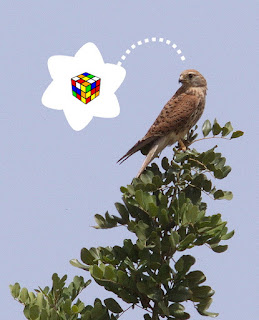
You may cheat the challenge from Rubik's cube by solving it through just seven auto-pilot steps, but taking the painstaking intellectual path without guidance is potentially million of times harder! However, in fact you will then (perhaps unintentionally) stretch your mental capacity and drastically improving your odds by invoking parallel processing. In this post I argue that this "trick" is very similar to the basic principles I'm touting by advocating Multi-scaled Random Walk (MRW), underlying the animal space use model.     Deep thinking by kestrel. Photo: AOG.        Theoretically, there are 43,252,003,274,489,856,000 (43 quintillion) possible combinations of Rubik moves if you do it by random steps. Mathematically, this approach satisfies a first-order Markovian process. In other words, the future is independent of the past, given the present. As I have repeatedly stated in my book, papers and in this blog, the standard theory of animal space use...

Deeper realism is needed in modelling of population dynamics

Image
Among vertebrates, most populations represent rare species. If this fact is not challenging enough in a survival perspective, all populations - whether rare or abundant - live in an open environment.  In some previous posts I've focused on survival-enhancing mechanisms like intraspecific cohesion from conspecific attraction. I have also pointed out the survival value of deterministic individual returns to a homestead following temporary long range excursions outside a given local population. Of course, such lifelines require individuals' cognitive capacity to relate to the environment an explicit spatio-temporal manner. In other words, to counteract the destructive effects of free dispersal beyond the local population's respective core areas, memory map utilization is key. Dispersal is an important aspect of animal space use optimization, but so is the advantage to returning home even over vast distances if this improves survival. If the memory premise becomes broadly accep...

CSSU: Bridging a theoretical model to real-life ecology

Image
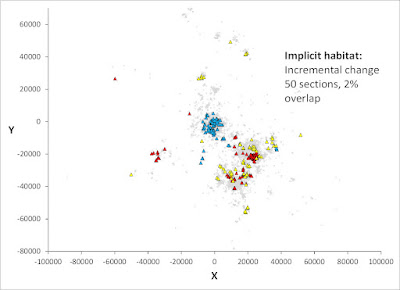
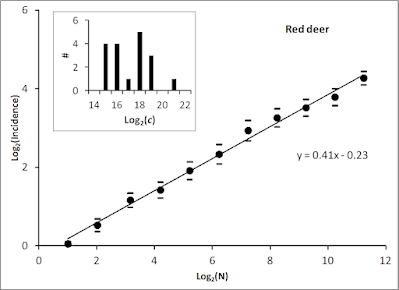
I have previously challenged readers to apply the MRW-based theory to explore animal space use from this alternative methodology. For example, by studying local strength of habitat utilization as indexed by CSSU (Characteristic Scale of Space Use), as a substitute for the traditional home range size estimates. Can this theoretical approach prove itself as a more realistic and sharp-edged statistical tool in some fields of behavioural ecology? We have previously provided some empirical pilot analyses on sets of GPS fixes. The results provide good coherence between model expectations and real data with respect to the biophysical process of memory utilization and scaling of habitat selection. However, what is still missing is a thorough ecological research into the often wide distribution of respective sets of CSSU estimates, as given by the parameter c .  While common methods to estimate home range sizes are influenced by the non-trivial effects of autocorrelation and sample siz...

Post no. 100: Further support of the "infinite home range size" paradox

Image
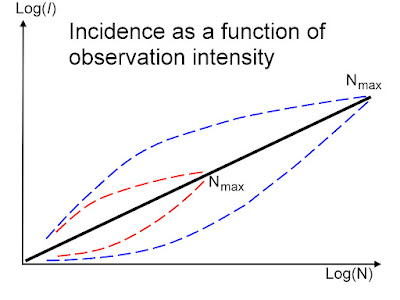
Memory map utilization by animals has received increased focus by behavioural ecologists. However, statistical and dynamic models in this field are in my view seriously lagging behind, as they are generally firmly glued to statistical-mechanical principles that defy the effects of realistic memory utilization.  Consequently, several statistical paradoxes haunt the classical modelling framework, due to unrealistic model assumptions. An alternative statistical-physical approach is required altogether. In this post I illustrate one specific space use property that emerges under the alternative model, the "infinitely expanding home range size" as a function of observation intensity. Paradox resolved, and practical applications offered! The current example underscores how this alternative framework may be applied in ecological analysis of animal space use and habitat selection.  Struggling to define "home range size" or "outlier fixes" from your GPS series? Wha...

Emergent properties of Animal Space Use - Part II

Image
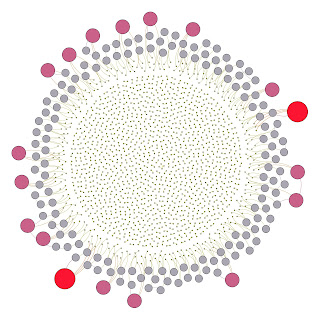
In Gautestad (2022) I explored the dual nature of Multi-scaled Random Walk (MRW), both from the network-topological and the spatio-temporal (Eulerian) angle. The results add additional weight to alternative methods to study behavioral-ecological aspects of site fidelity and habitat selection under influence of memory. In this follow-up post I toggle to the model's spatio-temporal aspects under various levels of stressed site fidelity. One of the new results of practical importance is application of a novel way to describe magnitude of serial autocorrelation in series of fix samples. A theoretical framework to study cognitive  movement ecology under condition of spatial memory and scale-free  habitat utilization continues to mature . Site fidelity that follows from an individual entering a locality that the individual prefers. The animal’s home range is growing in spatial extent over time due to the mixture of exploratory moves and occasional return events, but with a much...

Emergent properties of Animal Space Use - Part I

Image
Animal space use is complex, not only due to being complicated to understand in model terms but also from the philosophical perspective of the term "emergence". Qualitatively, we are then flipping from complicatedness to true complexity. Emergence of a system's behaviour occurs when an entity is observed to have properties its parts do not have on their own, properties or behaviors that emerge only when the parts interact in a wider whole. Recently I illustrated this fascinating topic in Frontiers in Ecology and Evolution (Gautestad 2022). Here the "parts" are represented by a large collection of an individual's relocations (sample of spatial fixes of movement) under influence of memory. Memory map utilization invites to study animal space use from two complementary perspectives, topologically and spatiotemporally. In Gautestad (2022) I cover both aspects; first, I use simulations involving memory-dependent site fidelity of an individual to explore in phenom...

Population Dynamics - the Bold Approach

Readers of my book and my blog are well aware of a critical attitude towards traditional population modelling, in particular because individual memory effects on long distance movement with a potential for returns are not accounted for. Thus, I have developed an alternative approach, the "Zoomer model", which has been presented in various posts. In this post you find short videos of simulations where the classical and the alternative approach are contrasted under very basic conditions. In the videos I  illustrate the profound difference between memory-less, Markov-compliant, scale-specific dynamics (the Paradigm) and scale-free, memory-influenced dynamics (the Zoomer model). These two classes of dynamics are exemplified to show the spatial redistribution effect on conspecific attraction, which is presented in two variants;  population re-distribution where the emerging pattern primarily is driven by such "intraspecific cohesion", and  the population kinetics is at s...

A Statistical-Mechanical Perspective on Site Fidelity – Part IIX

The power law expansion of observed space use in the  Multi-scaled random walk model (MRW) shows a non-trivial relationship with sample size N of spatial relocations (fixes). In this post I introduce imaginary numbers to resolve more precisely what I have called the apparent paradox of the time-independent inwards/outwards expansion with increasing N, as it emerges both from the spatial and the temporal aspect of the process. This novel development hopefully contributes to the continued bridge-building between biophysics and space use aspects of behavioural ecology. The inwards/outwards expansion in the MRW model is popping out of the Home range ghost formula  I (N) ≈  c √N  (Gautestad and Mysterud 2005), where incidence,  I , is the total area of fix-containing virtual grid cells. As verified repeatedly both theoretically and empirically,  I (N) is not simply a statistical small-sample size artifact, but an emerging property of the...

Random Returns Are Not Random

Image
The statistical-mechanical universality class Multi-scaled random walk (MRW) is a relatively recent addition to the menagerie of various types of random walk (RW). It seeks to capture some key aspects of animal space use, in particular the combined effects of spatio-temporal memory and scale-free movement. In this post I put focus on the statistical property of return events to previously visited positions (memory-dependent site fidelity). How can such events feasibly and realistically be treated as random, knowing that the animal by targeted returns will tend to revisit more profitable patches with a higher probability than other locations? In particular, one specific aspect  of the answer , revealed here in detail for the first time, will probably surprise you. Complexity turned into simplicity! What regards the the transition from deterministic behaviour to a RW process in general terms, search my blog for "Markov", or you may for example look into Gautestad (2013). To pla...

Roe Deer Comply With the MRW Model

Image
Animal space use expresses a balance between exploring new localities and returning to the known. However, as stated by Ranc  et al. (2020), the link between spatio-temporal resource patterns and animal movement has so far found limited experimental support. In their paper they found that following the loss of the individuals' preferred resource, roe deer Capreolus capreolus actively tracked resource dynamics leading to more exploratory movements, and larger, spatially-shifted home ranges. They also demonstrated the return of individuals to their familiar, preferred resource patches after local resource restoration. On the background of this interesting and dynamic habitat manipulation, I have allowed myself to drill into the raw GPS data as provided by their paper's Supplementary material. How does space use by  roe deer fit the Multi-scaled random walk (MRW) property of scale-free, memory-utilizing space use? Choosing a biophysical universality class of movement that ...