Spatial Analysis of Serially Autocorrelated Fixes
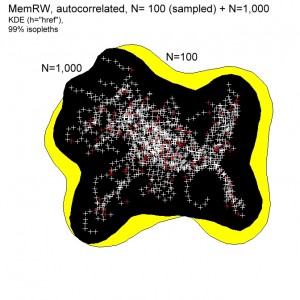
In previous posts I have mostly assumed serially non-autocorrelated fixes, and simulations have also reflected this coarse temporal sampling scale. However, in this post I started exploring the autocorrelation effect’s interesting statistical-mechanical properties. In this post I elaborate further on this theme, in particular its enhanced effect on the N-paradox under the kernel density estimation (KDE). From a statistical-mechanical perspective a high degree of coarse-graining of an animal’s space use is an advantage, due to a deep “hidden layer” and – consequently – better compliance with the ergodic principle in statistical mechanics. In short, system parameters are more precisely estimated when some spatio-temporal scale distance from the animal’s true path is achieved. In practice GPS series are often collected at high frequency in order to give large series for statistical analysis. This is an advantage for detailed ecological inference at the behavioural “micro-scale” of path ...