Posts

Temporally Constrained Space Use, Part I: Three Models

Image
Temporally constrained space use is a key property of animal movement. With respect to vertebrates three main statistical representations are particularly popular among modelers, based on disparate theoretical foundations. Which one should one use for analysis of a particular data set? As always in ecological research, one needs some simple protocol to distinguish between alternative model assumptions. Animals paths are neither straight lines nor a dense dot of positions from juggling back and forth at the same spot. Typically we see a complicated combination of these two extreme patterns; some quite straightforward moves occasionally abrupted by more jagged movement. In order to infer behavioural and ecological results from space use one needs to study the data in the context of a realistic theoretical framework. Outside the realm of temporal site fidelity; e.g., a drifting home range (Doncaster and Macdonald 1991), ecological textbooks typically explain the mixture of straight a...
Positive and Negative Feedback Part II: Populations

Image
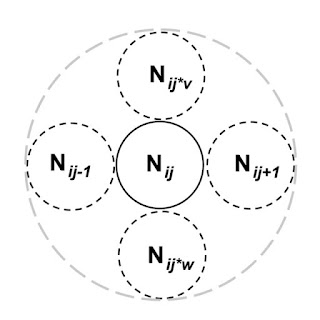
Examples of positive feedback loops in population dynamics abound. Even if the majority of models are focusing on negative feedback, like the logistic growth function, non-equilibrium “boom and bust” kind of model designs have also been developed. In this post I elaborate on the particular kind of positive feedback loop that emerges from cross-scale dual-direction flow of individuals that is based on the parallel processing conjecture. The image to the right illustrates – in simplistic terms – a spatially extended population model of standard kind (e.g., a coupled map lattice design) where each virtually demarcated local population j at spatial resolution i and at a given point in time t contains N ij individuals. No borders for local migration are assumed; i.e ., the environment is open both internally and externally towards neighbour sites.Typically, these individuals are set to be subject to a locally negative feedback loop in accordance to principles of density dependent regul...

Positive and Negative Feedback Part I: Individual Space use

Image
The standard theories on animal space use rest on some shaky behavioural assumptions, as elaborated on in my papers, in my book and here in my blog. One of these assumptions regards the assumed lack of influence of positive feedback, in particular the self-reinforcing effect that emerge when individuals are moving around with a cognitive capacity for both temporal and spatial memory utilization. The common ecological methods to study individual habitat use; like the utilization distribution (a kernel density distribution with isopleth demarcations), use/availability analysis, and so on, explicitly build on statistical theory that not only disregards such positive feedback, but in fact requires that this emergent property is not influencing the system under scrutiny. Unfortunately, most memory-enhanced numerical models to simulate space use are rigged to comply with negative rather than positive feedback effects. For example, the model animal successively stores its local experience w...

Analytical Sensitivity to Fuzzy Fix Coordinates

Image
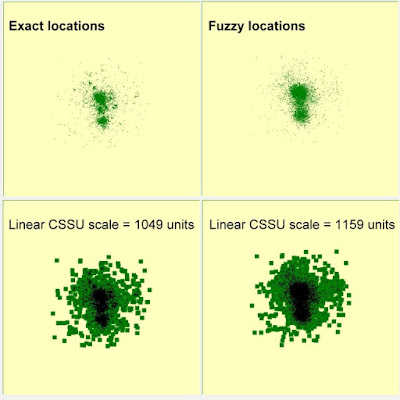
In empirical data GPS fixes are never exact positions. A “fuzziness field” will always be introduced due to uncertain geolocation. When analyzing a set of fixes in the context of multi-scaled space use, are the parameter estimates sensitive to this kind of statistical error? Simultaneously, I also explore the effect on constraining the potential home range by disallowing sallies to the outermost range of available area. To explore the triangulation error effect on space use analysis I have simulated Multi-scaled random walk in a homogeneous environment with N=10,000 fixes (of which the first 1,000 fixes were discarded) under two scenaria; a “sharp” location (no uncertainty polygons), and strong fuzziness. The latter introduced a random displacement to each x-y coordinate with a standard deviation (SD) of magnitude approximately equal to the system condition’s Characteristic scale of space use (CSSU). Displacements to the outermost parts of the given arena was disallowed, to study how...

The Balance of Nature?

Image
To understand populations’ space use one needs to understand the individual’s space use. To understand the individuals’ space use one needs to acknowledge the profound influence of spatio-temporal memory capacity combined with multi-scale landscape utilization, which continues to be empirically verified at a high pace in a surprisingly wide range of taxa. Complex space use has wide-ranging consequences for the traditional way of thinking when it comes to formulate these processes in models. In a nutshell, the old and hard-dying belief in the balance of nature needs a serious re-formulation, since complexity implies “strange” fluctuations of abundance over space, time and scale. A fresh perspective is needed with respect to inter-species interactions (community ecology) and environmental challenges from habitat destruction, fragmentation and chemical attacks. We need to address the challenge by rethinking also the very basic level of how we perceive an ecosystem’s constituents: how we ...

Simulating Populations X: Confronting Theory With Real Data

Image
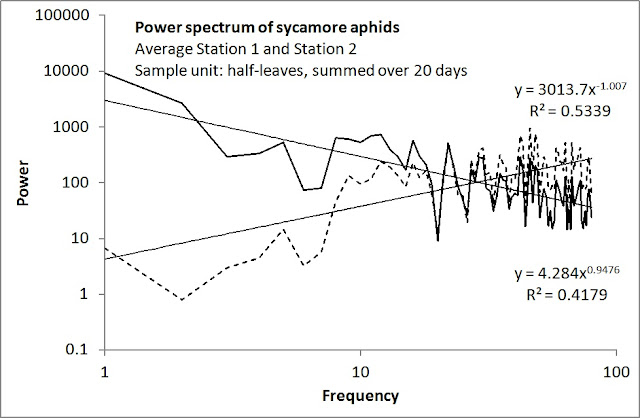
In Part IX a standard Coupled map lattice model was shown to be able to display a 1/f power spectrum, by careful tuning of one of the conditions for population mixing. On the other hand, I also showed that the Zoomer model under similar general conditions showed a higher resilience with respect to the 1/f property. In the present post I explore this statistical resilience of the Zoomer model further, by stressing the population system towards other corners of extreme conditions. However, I start by elaborating on this pressing question: Why this recurrent focus on 1/f noise? To stimulate your curiosity I also reproduce from my book two analyses of empirical data; the sycamore aphid Drepanosiphum platanoides and the leaf miner Leucoptera meyricki . First, a brief bird’s view of complex dynamics. I have repeatedly given partly answers to the question “why focusing on 1/f noise?”, but here I seek to give you a broader perspective, starting with a citation from Scholarpedia: 1/f fluc...

Simulating Populations IX: Tuning a Classic CML Model In and Out of Pink Noise

Image
In the previous post I presented a time series of the Zoomer model, verifying a 1/f (pink) noise signature. For the sake of comparison I here present a series from scale-specific dynamics (standard Coupled map lattice model) using a comparable system setup. Interestingly, some specific similarities with some statistical aspects of the Zoomer model is appearing, given some “Fine tuning” of conditions. However, some aspects are able to pinpoint the difference anyway. The present CML model conditions are the same as for the Zoomer version with 5-scale zooming of 1% zoomers pr. scale level and time increment, except for replacing zooming with 1% diffusion between neighbour cells at unit scale. Recall from previous posts in this series – and from the older post where the Zoomer model was described in mathematical terms (search Archive) – that zooming has a component of intraspecific cohesion. In contrast, diffusion is a memory-less (Markov compliant) kind of re-distribution of individua...