Posts

A Statistical-Mechanical Perspective on Site Fidelity – Part V
Image
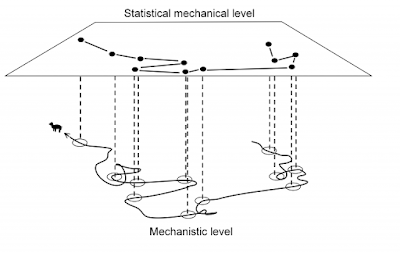
Two important statistical-mechanical properties need to be connected to the home range concept under the parallel processing postulate; micro- and macrostates. When a system is in its equilibrium state, (a) all microstates are equally probable and (b) the observed macrostate is the one with the most microstates. The equilibrium state implies that entropy is maximized. First consider a physical system consisting of indistinguishable particles. For example, in a spatially constrained volume G of gas (a classical, non-complex system) that consists of two kinds of molecules, at equilibrium you expect a homogeneous mixture of these components. At every virtually defined locality g within the volume, the local density (N/g) of each type of molecule is expected to be the same, independently of the resolution of the two- or three-dimensional virtual grid cell g we use to test this prediction. This homogeneous state is in compliance with a prediction based on the most probable macrostate fo...

Three Important MRW Model Assumptions Confirmed

Image
My statistical-mechanical model representative for simulation parallel processing – the Multi-scaled random walk (MRW) – unifies two traditionally disparate directions of research; theory for site fidelity (area-restricted space use, the home range) and theory for scale-free movement (Lévy walk-like). Space use is represented by a set of relocations (fixes). The fixes are assumed to be collected at a sufficiently large interval (lag) to ensure a statistical-mechanical representation of the system. MRW is characterized by a wide range of system properties. Some have been explored by simulations and subsequently supported by empirical pilot tests on a wide range of vertebrates. However, verification of some model assumptions have been left behind for another day. Here I catch up with three of them. I have previously described the individual’s characteristic scale of space use, CSSU, as the MRW model’s proposed substitute for the problematic “home range size” concept. Using serially n...

Spatial Analysis of Serially Autocorrelated Fixes

Image
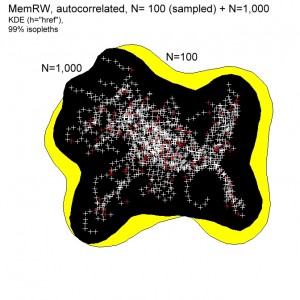
In previous posts I have mostly assumed serially non-autocorrelated fixes, and simulations have also reflected this coarse temporal sampling scale. However, in this post I started exploring the autocorrelation effect’s interesting statistical-mechanical properties. In this post I elaborate further on this theme, in particular its enhanced effect on the N-paradox under the kernel density estimation (KDE). From a statistical-mechanical perspective a high degree of coarse-graining of an animal’s space use is an advantage, due to a deep “hidden layer” and – consequently – better compliance with the ergodic principle in statistical mechanics. In short, system parameters are more precisely estimated when some spatio-temporal scale distance from the animal’s true path is achieved. In practice GPS series are often collected at high frequency in order to give large series for statistical analysis. This is an advantage for detailed ecological inference at the behavioural “micro-scale” of path ...

Lévy Walking or Not Lévy Walking – That’s the Question

Image
As summarized and reviewed by many, one of the hot topics in the field of movement ecology regards to what extent – and under which ecological conditions – an animal performs scale-free movement. As readers of my book and my blog definitely have observed, I advocate a distinction between several kinds of scale-free movement (summarized by the Scaling cube); in particular, (a) the standard battleground of Lévy walk vs. Brownian motion (scale-free vs. scale-specific movement) (b) Lévy walk vs. composite random walk (a “Lévy walk look-alike”, i.e., pseudo-scale-free movement), and (c) Multi-scaled random walk (MRW; scale-free movement with site fidelity). The third variant has so far not received much attention in this debate. This is in my view unfortunate, because this approach apparently has the potential to resolve much of the controversy! It is a fact that empirical research on scale-free vs. scale-specific movement generally has ignored the effect from animal site fidelity. This i...

A Statistical-Mechanical Perspective on Site Fidelity – Part IV

Image
In Part I of this set of posts I described animal space use from the perspective of ergodicity. This is a key concept of standard statistical mechanics, with similar importance to analysis of individual paths and home range data under the extended theoretical framework (the parallel processing conjecture, expressed by the MRW model). Below I elaborate on this theme. I indicate by simulation examples the transition from a fully ergodic state on the home range scale to a narrowing of this scale as the series of fixes become increasingly autocorrelated (higher-frequency sampling). From a biophysical perspective, the following system description may point towards my most important theoretical development since the Scaling cube. This will become clearer as I gradually turn my upcoming posts from description of statistical-mechanical properties towards how to explore these properties in novel methods for ecological inference. First consider the general principle that the transition from ...

Population Dispersion under Scale-Free Memory Influence

Image
Over the years the term “density” has provided a convenient variable for ecological inference, since it has a clear definition both at the individual level and the population level. For example, GPS fix density for a given individual and sample size of fixes is proportional with the inverse of the demarcated home range size when this is the area unit. By assuming the standard asymptote model for home range area, fix density N/area is higher when area is smaller. The MRW model, which contradicts the asymptote assumption and is incompatible with the density surface (UD) as a proper proxy for local space use intensity, still presents a proxy variable for intensity of habitat use. In the MRW model the traditional density=N/area is replaced by H=(√N)/c‘ where c‘ is the individual’s characteristic scale of space use, CSSU. Thus, H is proportional with the inverse of CSSU. Contrary to density, which assumes area is intrinsically constant (the asymptote), H adjusts for N-sensitive area dema...

KDE – an Obstacle to Ecological Inference?

Image
In the two foregoing posts I have been quite critical to one of the preferred home range analytical tools among wildlife ecologists, the kernel density estimation (KDE). I have underscored two main points; the well-documented (but mainly ignored) N-paradox and the issue this raises with respect to camouflaging important aspects of the animals’ space use behaviour. In this post I provide an additional illustration of the latter point, and I discuss the serious problem this shortcoming raises for ecological inference based on – for example – GPS fixes (for details and additional examples, see my book). First, a more detailed confirmatory illustration of KDE’s N-paradox. Above I have plotted the 99% isopleths based on a range of sample sizes of fixes, N (open symbols) and compared the result to the alternative area demarcation method incidence (number of non-empty virtual grid cells; filled symbols). The data sets are the series from the two foregoing posts. The “KDE compatible” sp...