Posts

The Parallel Processing Concept – Part II

Image
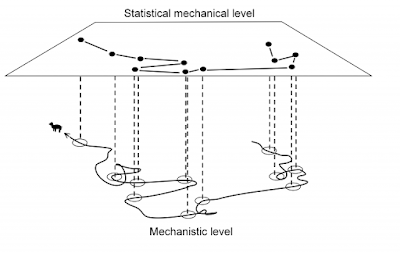
In my book I devote several chapters to explain, illustrate, simulate and mathematically formulate the parallel processing (PP) principle. PP represents the foundation of the extended statistical-mechanical framework that I propose as necessary to model complex space use more realistically. In this Part II of the PP description I elaborate further on this unfamiliar approach, which represents an alternative to the standard “Markov process” (mechanistic) methods in movement ecological theory. Hopefully the reader of my book and these supplementary blog posts will manage the difficult task to be both critical and open-minded. After all, I have formulated several testable hypotheses, where the null hypothesis is the standard framework and the alternative hypothesis is the PP-compliant process. Several pilot tests on real animal space use are presented in my book and in our papers, lending support to a PP kind of space use; spatio-temporal memory utilization in combination with a multi-s...
What About Intra-Home Range Fix Density?

Image
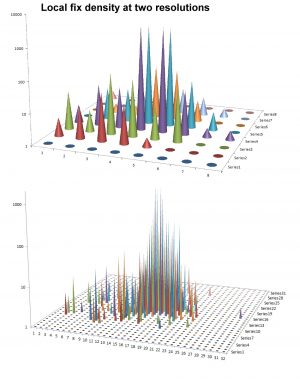
In a previous blog post I summarized an alternative approach to estimate local habitat selection, based on the individual’s characteristic scale of space use, CSSU, rather than local density of fixes (the utilization distibution, UD). In the present post I compare the density-based UD with local variation of CSSU in the context of habitat selection, using both simulated and real space use. Despite being critical to the traditional UD approach I also argue that density of fixes may still reveal important properties of value for ecological inference, and I describe this by an example. In my book I argue strongly against using the traditional UD model as a proxy for strength of intra-home range habitat selection. The UD reflects local density of fixes. The reason for my critique is the UD’s intrinsically self-similar (fractal) structure under realistic home range conditions, while theoretical UD models are inherently non-fractal (“statistically smooth surface at fine resolutions”). The ...

The Parallel Processing Concept – Part I

Image
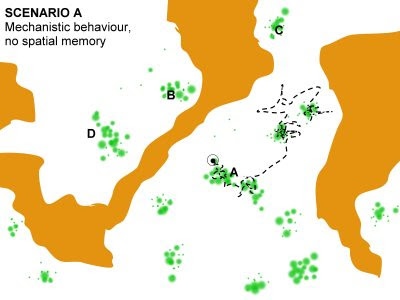
In my book I summarize the statistical mechanics behind the dominating framework for animal space use models; mechanistic behaviour. This framework comes in two main “flavours”; with and without spatial memory. However, following this introduction the book is devoted to a third approach, based on non-mechanistic behaviour; called parallel processing. In a new series of blog posts, I start by showing how to discriminate between these three scenaria at the conceptual level  In fact, as shown in the Scaling cube (search Archive) I demarcate eight statistical-mechanical flavours of space use; called universality classes of space use, but let’s keep it simpler here. First, consider a habitat playground like the one in the image to the right. White and brown area represents the matrix environment. White habitat is not selected for (basically, providing transit zones) while brown areas are landscape parts that are actively avoided. Green patches represent habitat elements – “resource...

A Statistical-Mechanical Perspective on Site Fidelity – Part V

Image
Two important statistical-mechanical properties need to be connected to the home range concept under the parallel processing postulate; micro- and macrostates. When a system is in its equilibrium state, (a) all microstates are equally probable and (b) the observed macrostate is the one with the most microstates. The equilibrium state implies that entropy is maximized. First consider a physical system consisting of indistinguishable particles. For example, in a spatially constrained volume G of gas (a classical, non-complex system) that consists of two kinds of molecules, at equilibrium you expect a homogeneous mixture of these components. At every virtually defined locality g within the volume, the local density (N/g) of each type of molecule is expected to be the same, independently of the resolution of the two- or three-dimensional virtual grid cell g we use to test this prediction. This homogeneous state is in compliance with a prediction based on the most probable macrostate fo...

Three Important MRW Model Assumptions Confirmed

Image
My statistical-mechanical model representative for simulation parallel processing – the Multi-scaled random walk (MRW) – unifies two traditionally disparate directions of research; theory for site fidelity (area-restricted space use, the home range) and theory for scale-free movement (Lévy walk-like). Space use is represented by a set of relocations (fixes). The fixes are assumed to be collected at a sufficiently large interval (lag) to ensure a statistical-mechanical representation of the system. MRW is characterized by a wide range of system properties. Some have been explored by simulations and subsequently supported by empirical pilot tests on a wide range of vertebrates. However, verification of some model assumptions have been left behind for another day. Here I catch up with three of them. I have previously described the individual’s characteristic scale of space use, CSSU, as the MRW model’s proposed substitute for the problematic “home range size” concept. Using serially n...

Spatial Analysis of Serially Autocorrelated Fixes

Image
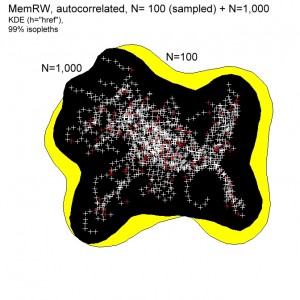
In previous posts I have mostly assumed serially non-autocorrelated fixes, and simulations have also reflected this coarse temporal sampling scale. However, in this post I started exploring the autocorrelation effect’s interesting statistical-mechanical properties. In this post I elaborate further on this theme, in particular its enhanced effect on the N-paradox under the kernel density estimation (KDE). From a statistical-mechanical perspective a high degree of coarse-graining of an animal’s space use is an advantage, due to a deep “hidden layer” and – consequently – better compliance with the ergodic principle in statistical mechanics. In short, system parameters are more precisely estimated when some spatio-temporal scale distance from the animal’s true path is achieved. In practice GPS series are often collected at high frequency in order to give large series for statistical analysis. This is an advantage for detailed ecological inference at the behavioural “micro-scale” of path ...

Lévy Walking or Not Lévy Walking – That’s the Question

Image
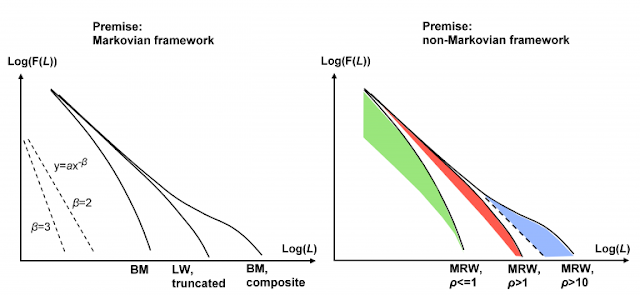
As summarized and reviewed by many, one of the hot topics in the field of movement ecology regards to what extent – and under which ecological conditions – an animal performs scale-free movement. As readers of my book and my blog definitely have observed, I advocate a distinction between several kinds of scale-free movement (summarized by the Scaling cube); in particular, (a) the standard battleground of Lévy walk vs. Brownian motion (scale-free vs. scale-specific movement) (b) Lévy walk vs. composite random walk (a “Lévy walk look-alike”, i.e., pseudo-scale-free movement), and (c) Multi-scaled random walk (MRW; scale-free movement with site fidelity). The third variant has so far not received much attention in this debate. This is in my view unfortunate, because this approach apparently has the potential to resolve much of the controversy! It is a fact that empirical research on scale-free vs. scale-specific movement generally has ignored the effect from animal site fidelity. This i...