Posts

MRW and Ecology – Part II: Space Use Intensity
Image
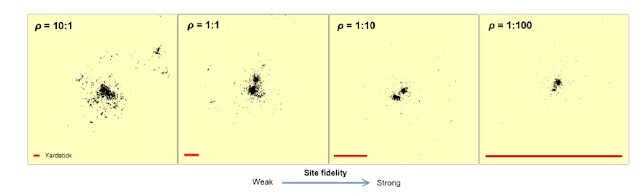
Through the history of ecological methods, local intensity of habitat use has been equalized with local density of relocations. Using relative density as a proxy variable for intensity of habitat use rests on a critical assumption which few seems to be aware of or pay attention to. In this second post on Multi-scaled random walk (MRW) applications for ecological inference I describe a simple method, which rests on an alternative assumption with respect to space use intensity, applicable under quite broad behavioural and ecological conditions. One immediate proposal for application is analysis of habitat selection. First, consider counting number of GPS fixes, N, within respective area segments of a given habitat type h, A h1 , A h2 , …, A hi , …A hk , and calculating the average N pr. area unit of type h. Next, consider comparing this density D h with another density within a second habitat type j; i.e., D j , using the same area scale for comparison. If Dh>Dj one traditionally ...

MRW and Ecology – Part I: Introduction

Image
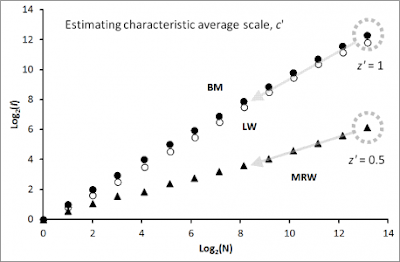
In this “MRW and Ecology” series of posts I present summaries of simple ecological methods – based on alternative basic assumptions – for analysis of common ecological aspects of animal space use. These proposals are spin-offs of the first direction of research to explicitly break out of the Markovian strait-jacket in the present context. A broadened analytical approach – involving a qualitative shift of direction – is in my view clearly needed, as documented by the rapidly growing line of high quality and deep-level analyses of empirical data now appearing. For such an alternative direction the parsimonious Multi-scaled random walk model (MRW) may provide a feasible starting point. Over the years the MRW approach has been successfully tested empirically against the prevailing paradigm’s basic assumptions, or indirectly supported by alternative interpretations of respective analyses of space use and movement. Thus, now it’s time to step forward from testing behavioural feasibility of ...

Random Walk Should Not Imply Random Walking

Image
Random walk is one of the most sticky concepts of movement ecology. Unfortunately, this versatile theoretical model approach to simplify complex space use under a small set of movement rules often leads to confusion and unnecessary controversy. As pointed out by any field ecologist, unless an individual is passively shuffled around in a stochastic sequence of multi-directional pull and push events, the behavioural response to local events and conditions is deterministic! An animal behaves rationally. It successively interprets and responds to environmental conditions – within limits given by its perceptive and cognitive capacity – rather than ignoring these cues like a drunken walker. Any alternative strategy would lose in the game of natural selection. Still, from a theoretical perspective an animal path may still be realistically represented by random walk – given that the randomness is based on properly specified biophysical premises and the animal adhere to these premises. Outs...

The Lesser Kestrel: Natal Dispersal In Compliance With The MRW Model

Image
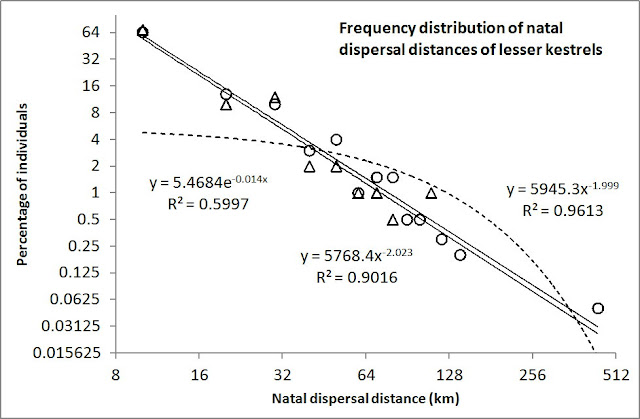
The Multi-scaled random walk (MRW) model defines a specific dispersal kernel for animal movement; a power law, which is qualitatively different from standard theory (a negative exponential function). Alcaide et al. (2009) analyzed long-term ringing programmes of the lesser kestrel Falco naumanni in Western Europe, and showed results from re-encounters of 1308 marked individuals in Spain. They found that most first-time breeders settled within 10 km from their natal colony (i.e., a strong philopatric tendency), with a negative association between natal dispersal and geographical distance. While Alcaide et al . (2009) were mainly concerned with gene flow and population effects, here I take a deeper look at their dispersal data and find strong support for MRW-compliant behaviour in the natal dispersal data. Indirectly, this pattern at the individual level also supports the MRW-analogue at the population level, the Zoomer model (Gautestad 2015). I allow myself to copy their Figure 1, s...

The Florida Snail Kite: Linking Individual MRW to Population Kinetics?

Image
The theoretical framework of the traditional space use models (“the Paradigm”) shows strong mathematical coherence between individual movement and its population level representation. Basically (in its simplest and most parsimonious form), standard random walk representing individual statistics is compliant with standard diffusion representing population statistics. Further, the trunk of the toolbox of statistical methods in space use ecology is also resting on assumptions from the Paradigm. However, the Paradigm and its large family of sophisticated sub-models is now under increasing attack from many directions – directly or indirectly – due to the growing pool of empirical results that cast doubt on its common, core assumptions. For example, recent analyses of the snail kite Rostrhamus sociabilis plumbeus in Florida indicate that individuals of this dietary specialist show a surprising capacity to rapidly adapting to changing conditions over a large range of spatial scales from loca...

Patch Use by Bison in Canada: Memory and Habitat Exploration

Image
Merkle et al. (2014; 2017) have developed and tested a sophisticated memory-including patch selection model for free-ranging bison ( Bison bison ). Some of the empirical results add support to the Multi-scaled Random Walk (MRW) model (Gautestad and Mysterud 1995, 2005; Gautestad 2015), while other aspects require further details of the bison data to evaluate the potential for full compliance. In Merkle et al .’s simulation model; which is described by both a Lagrangian and a quasi-Eulerian variant (integro-difference equation, leading to similar results), animals use spatial and attribute memory to choose food patches based on three components: whether or not they have previously visited them, their reference point of patch profitability derived from recent foraging experience, and their memory of the profitability of each previously visited patch. First, the results confirm home range as an emergent property of spatial memory. Animals returning to previously visited patches wit...

Animal Migration: Tactical Freedom During Strategic Constraint

Image
Recent research on animal migration continue to challenge the paradigm of assuming relatively straight-line routes between start locations and respective targets, as shown in a study on blackpoll warblers Setophaga striata (Brown and Taylor 2017). The warblers had a surprisingly high degree of back-and-forth displacements during migration; apparently more than can be explained by adjusting steps to local habitat attributes along the path. Migration regards an endpoint on the scale continuum from short term movement bouts to long-distance seasonal displacements. Thus, one of the core challenges for more realistic models in wildlife ecology regards how to conceptualize and then formulate (in short: understand from simulations and from testing model predictions) the multi-scaled cognitive processing of environmental information and displacement decisions in animals. This insight should account for all time resolutions up to the migration scale. From Insecta to Aves and Mammalia , i...