Posts

A Statistical-Mechanical Perspective on Site Fidelity – Part VII
Image
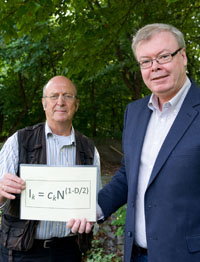
Animal space use analysis should be less focused on home range area demarcations and rather explore methods for statistical-mechanical studies of the set of spatial relocations (fixes). The latter approach appears more compatible with a scale-free and memory-influenced habitat utilization, which has recently been repeatedly verified in many species. In this post I develop the theoretical foundation behind the matching scale-free/memory-driven MRW model one step further by clarifying the dual aspect of observation intensity, which I find necessary in complex systems analyses of animal space use. I also show how a change of intensity has to be coherently linked to the concept of system entropy. This post regards a follow-up on A Statistical-Mechanical Perspective on Site Fidelity – Part I-VI posted during February 1, 2016 to October 7, 2016 (search Archive).  First, recall that the parsimonious "home range ghost" formula for scale-free and memory influenced space use (the Mult...
Parallel Processing: Towards a Broadened Biophysics of Space Use, Part III

Image
In this post I will again hammer wake-up calls into my own camp, researchers in the field of wildlife ecology, including the theory of habitat selection and and animal space use. For example, I have previously claimed that the Burt legacy has hampered progress in individual home range modelling, as has standard calculus done for population dynamics of open systems (including spatially extended versions). The two classical toolboxes for space use models; based on specific postulates from statistics and standard mathematics, are hampering progress towards improved model realism. As long as there still is a strong reluctance to replace these postulates by extending the theory head-on in the direction of biophysics of memory-influenced processes it is my personal conviction that the quagmire will prevail. However, there are now rapid and promising progress from research originating outside the traditional community of ecologists. These directions are pointing towards spatial models from ...

Parallel Processing: Towards a Broadened Biophysics of Space Use, Part II

Image
When I returned to the University of Oslo in 1990 to explore alternative pathways towards complex dispersion of populations it was natural to start out by orbiting around the Department of biology’s division that focused on population dynamical modelling. However, what became increasingly obvious was a tension that grew up between my choice of off-piste approaches, the introduction of rather unorthodox concepts and on the other side meeting a culture that stubbornly focused on the classical mathematical and statistical toolbox. I simply could not find satisfactory local support for working on scale-free dispersal processes under these terms, despite what I observed as thoroughly and broadly documented instances of such paradigm-breaking behaviour in the hundreds of papers surrounding confirmation of – for example – Taylor’s power law and fractal-patterned population dispersion. The theoretical culture was shying away from exploring a series of paradoxes that in my view were crying for ...

Parallel Processing: Towards a Broadened Biophysics of Space Use, Part I

Image
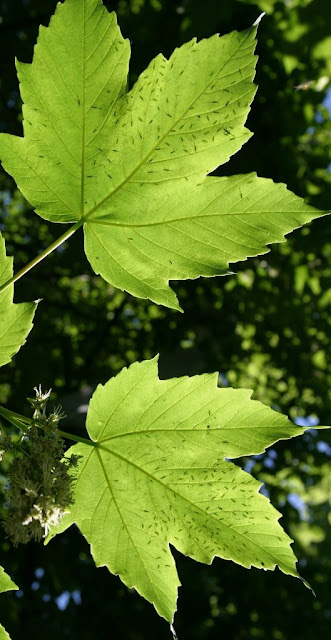
This series of posts is an attempt to briefly summarize historically the conceptual development of the Parallel processing idea (PP) as a modelling framework to better understand the complex space use by animals. The endeavor started by a couple of enlightening Eureka moments, and swiftly split into two lines of approach. The challenge was to get the grips of the deeper process behind scale-free dispersion. This fascinating behaviour would in my view have to be coherently modelled along two lines of exploration, first from the perspective of spatio-temporal population dynamics and then from individual space use. PP was born during those early periods of confusion and frustration, and it has focused (some will say haunted) my research for more than 30 years. Picture: Spaced-out gregariousness in sycamore aphids Drepanosiphum platanoides under tree leaves in Oslo, Norway. Photo: AOG. At the population side it all started out with a couple of frustrating years exploring mathematica...

Non-Mechanistic Dynamics: a Simple Illustration

Image
In my previous post I summarized my critique of mechanistic modelling when applied on animal movement. Simply stated, the Markovian design on which mechanistic models depend is in my view incompatible with a realistic representation of memory-influenced and scale-free space use. Below I illustrate the alternative approach, non-mechanistic dynamics, by a simple Figure. As conceptually described by the Scaling cube, an extra system dimension based on relative scale (“hierarchical scaling” of the dynamics), resolves the apparent paradox of non-mechanistic dynamics. I cite from my first post on the Scaling cube (December 25, 2015): The scaling cube brings these directions of research together under a coherent biophysics framework. It also forces upon us a need to differentiate between mechanistic dynamics (the M-floor) and non-mechanistic dynamics (the PP-ceiling). As a supplement to my book presentation I have published a series of posts on this theme, where its unfamiliar nature ha...

On the Paradox of Mechanistic Movement Models

Image
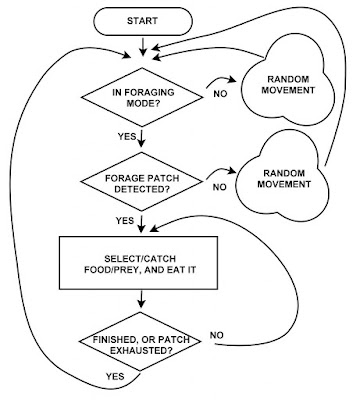
Mechanistic design is still dominating animal space use modelling. As the readers of my papers, book and blog have understood I’m very critical to this framework. In particular, because both mechanics and standard statistical mechanics – due to their dependence on Markovian dynamics seem to be unable to implement memory-influenced movement in a realistic manner. Thus, paradoxes abound. Unfortunately most theoreticians in movement ecology either do not care or do not know how to approach this issue. In this post I seek to pinpoint the most basic challenge, and how it may be potentially resolved by exploring a qualitatively new direction of modelling. Consider the standard, simplified illustration of animal foraging, which takes up much of an individual’s focus during a day. At each time increment the behaviour adheres to rules under the mathematical framework of a low order Markovian process. A similar diagram could have been shown for other behavioural modes; like looking for a mat...

Intraspecific Cohesion From Conspecific Attraction, Part III: A Simple Test

Image
In the real world, animals typically tend to congregate at the landscape scale, even when they show repellence at finer scales (territorial behaviour). In contrast, one of the basic assumptions of the vast majority of mathematical population models is independent space use by individuals. In other words, it is assumed that the individuals do not show conspecific attraction but adhere to “full mixing” from independent space use. A strange assumption, indeed! Using the part of the Parallel processing theory (PP) that was summarized in Part I and Part II it is a simple statistical exercise to test if a given population’s dispersion obeys the full mixing assumption (the Paradigm); or alternatively, indicating a positive feedback tendency from PP-compliant space use (the Zoomer model). The concept of conspecific attraction is verified among many species and taxa of animals. For example, lizards prefer to settle near conspecifics, even when unoccupied habitat is available nearby (Stamps 1...